

In the field of industrial automation and instrumentation, isolation transmitters play a crucial role in ensuring accurate and reliable signal transmission. One of the key performance indicators of an isolation transmitter is its linearity error. This blog post aims to explore what linearity error is, why it matters, and how it relates to our offerings as an isolation transmitter supplier.
Understanding Linearity Error
Linearity error is a measure of how closely the output of a device follows a straight - line relationship with its input. In the context of an isolation transmitter, it represents the deviation of the actual output signal from the ideal linear output over the specified input range.
Let's consider an ideal isolation transmitter. For a given input signal, say a current signal in the range of 4 - 20 mA, the output should change linearly with the input. If the input increases from 4 mA to 20 mA, the output should change in a perfectly proportional manner. However, in real - world scenarios, this is not always the case.
The linearity error is typically expressed as a percentage of the full - scale output. For example, if an isolation transmitter has a full - scale output range of 0 - 10 V and a linearity error of ±0.1%, the maximum deviation from the ideal linear output within the full - scale range is ±0.01 V.
Why Linearity Error Matters
Accurate signal transmission is essential in industrial applications. Many control systems rely on precise input signals to make decisions and adjust processes. A high linearity error can lead to inaccurate readings, which in turn can cause process inefficiencies, product quality issues, and even safety hazards.
In a chemical processing plant, for instance, the level of a liquid in a tank is measured using a sensor, and the signal is transmitted through an isolation transmitter to a control system. If the isolation transmitter has a significant linearity error, the control system may receive an inaccurate reading of the liquid level. This could result in over - filling or under - filling of the tank, leading to waste of materials or potential safety risks.
Measuring Linearity Error
There are several methods to measure the linearity error of an isolation transmitter. One common approach is the end - point method. In this method, the ideal straight line is defined by the two end - points of the input - output characteristic curve. The actual output values at various input points are then compared to the values on the ideal straight line, and the maximum deviation is calculated as the linearity error.
Another method is the best - fit straight - line method. Here, a straight line is fitted to the actual input - output data points using a mathematical algorithm such as the least - squares method. The maximum deviation of the actual data points from this best - fit line is considered the linearity error.
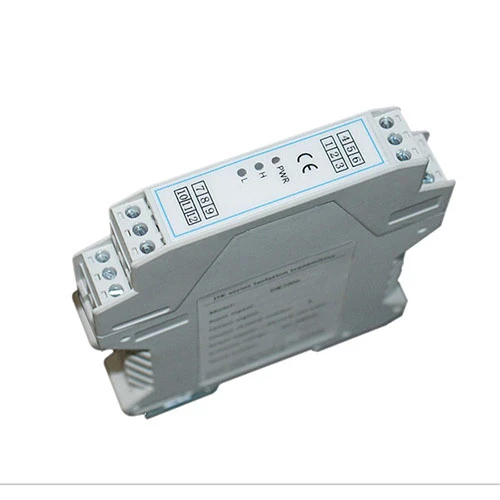

Our Isolation Transmitter Offerings and Linearity Error
As an isolation transmitter supplier, we understand the importance of low linearity error in our products. We offer a wide range of isolation transmitters designed to meet the diverse needs of our customers.
Our Dual - Channel Passive 4 - 20mA Transmitter is a prime example. This transmitter is designed to provide accurate and reliable signal isolation for two channels simultaneously. It has a very low linearity error, ensuring that the output signals are highly proportional to the input signals. This makes it ideal for applications where multiple signals need to be transmitted accurately, such as in large - scale industrial control systems.
The Wre5 - wre26 Signal Isolation and Transmission Device is another product in our portfolio. It is specifically designed for applications where high - precision signal isolation is required. With its advanced design and high - quality components, this device offers excellent linearity performance, minimizing the risk of signal distortion and inaccuracies.
Our Temperature Signal Conversion Transmitter is tailored for temperature measurement and control applications. Temperature signals can be particularly sensitive, and any linearity error can lead to significant temperature measurement inaccuracies. Our transmitter is engineered to have a very low linearity error, ensuring that the temperature readings are as accurate as possible.
Factors Affecting Linearity Error
Several factors can affect the linearity error of an isolation transmitter. One of the main factors is the quality of the components used in the transmitter. High - quality resistors, capacitors, and operational amplifiers are essential for achieving low linearity error.
The design of the transmitter circuit also plays a crucial role. A well - designed circuit can minimize the effects of noise, interference, and component non - linearities. Additionally, environmental factors such as temperature, humidity, and vibration can impact the linearity performance of the transmitter. Our isolation transmitters are designed to be robust and resistant to these environmental factors, ensuring consistent linearity performance over a wide range of operating conditions.
Minimizing Linearity Error in Our Products
To minimize the linearity error in our isolation transmitters, we follow a strict quality control process. Our products are thoroughly tested during the manufacturing process to ensure that they meet our high - quality standards. We use advanced testing equipment and techniques to measure the linearity error accurately and make any necessary adjustments.
We also invest in research and development to continuously improve the design and performance of our products. By using the latest technologies and materials, we are able to reduce the linearity error and enhance the overall accuracy of our isolation transmitters.
Conclusion
Linearity error is a critical parameter for isolation transmitters. It directly affects the accuracy and reliability of signal transmission in industrial applications. As an isolation transmitter supplier, we are committed to providing our customers with products that have low linearity error. Our Dual - Channel Passive 4 - 20mA Transmitter, Wre5 - wre26 Signal Isolation and Transmission Device, and Temperature Signal Conversion Transmitter are all designed to offer excellent linearity performance.
If you are in need of high - quality isolation transmitters with low linearity error, we invite you to contact us for procurement and further discussions. Our team of experts is ready to assist you in finding the right solution for your specific application.
References
- "Industrial Instrumentation and Control Handbook", Third Edition, edited by Bela G. Liptak
- "Signal Conditioning for Industrial Sensors", by John C. Daugherty