

Hey there! As a supplier of isolation transmitters, I often get asked about the gain error of these nifty devices. So, I thought I'd sit down and write a blog post to explain what gain error is all about, why it matters, and how it can impact the performance of isolation transmitters.
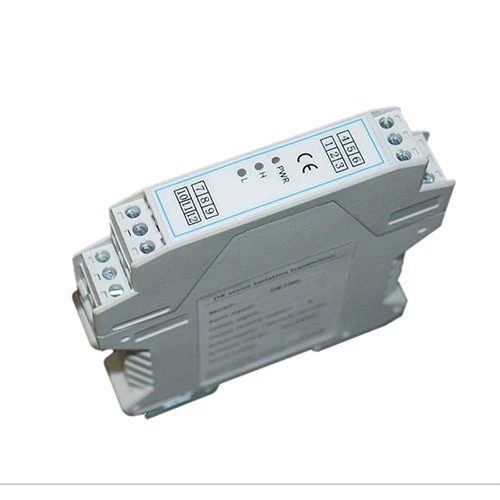
Let's start with the basics. An isolation transmitter is a device that takes an input signal, isolates it from the output signal, and then amplifies or conditions the output signal to match a specific range or format. These transmitters are commonly used in industrial, automation, and instrumentation applications to protect sensitive equipment from electrical noise, ground loops, and other interference.
Now, gain error is a measure of how accurately an isolation transmitter amplifies or attenuates an input signal. In simple terms, it's the difference between the actual output signal and the expected output signal, expressed as a percentage of the full-scale output range. For example, if an isolation transmitter is designed to have a gain of 1 and the actual gain is 1.01, the gain error would be 1%.
So, why does gain error matter? Well, in many applications, accuracy is crucial. For instance, in a process control system, a small gain error in an isolation transmitter could lead to inaccurate measurements, which in turn could cause the system to malfunction or produce suboptimal results. In a data acquisition system, gain error could affect the quality of the data being collected, leading to incorrect analysis and decision-making.
There are several factors that can contribute to gain error in an isolation transmitter. One of the main factors is component tolerance. Every electronic component has a certain degree of variability in its performance, and this variability can accumulate over time and affect the overall gain of the transmitter. Temperature is another important factor. Changes in temperature can cause the electrical characteristics of the components in the transmitter to change, which can lead to gain error.
Another factor that can affect gain error is the quality of the power supply. A noisy or unstable power supply can introduce fluctuations in the output signal, which can result in gain error. Additionally, the load impedance connected to the output of the transmitter can also have an impact on gain error. If the load impedance is too low or too high, it can cause the output signal to deviate from the expected value.
To minimize gain error in an isolation transmitter, manufacturers typically use high-quality components with tight tolerances. They also implement temperature compensation techniques to ensure that the gain remains stable over a wide range of temperatures. In addition, proper power supply filtering and load impedance matching can help reduce the impact of external factors on gain error.
Now, let's take a look at some of the isolation transmitters that we offer as a supplier. We have a wide range of products to meet the diverse needs of our customers. One of our popular products is the Wre5 - wre26 Signal Isolation and Transmission Device. This device is designed to provide high - accuracy signal isolation and transmission, with low gain error and excellent stability.
Another great product is the AC/DC Voltage Current Power Isolation Transmitter. This transmitter is suitable for applications where accurate measurement and isolation of AC and DC voltage, current, and power signals are required. It offers high - precision performance and low gain error, making it a reliable choice for many industrial and automation applications.
We also have the 1 - In - 6 - Out Intelligent Data Acquisition Module. This module is designed to provide multiple isolated outputs from a single input signal, with high accuracy and low gain error. It's ideal for data acquisition systems where multiple signals need to be monitored and processed simultaneously.
If you're in the market for an isolation transmitter and are concerned about gain error, it's important to choose a product that offers high accuracy and stability. At our company, we take pride in offering high - quality isolation transmitters that are designed to minimize gain error and provide reliable performance.
When you're evaluating different isolation transmitters, make sure to look at the specifications provided by the manufacturer. Pay close attention to the gain error specification, as well as other important parameters such as linearity, temperature coefficient, and power supply requirements. It's also a good idea to read customer reviews and testimonials to get an idea of how the product performs in real - world applications.

In conclusion, gain error is an important consideration when choosing an isolation transmitter. By understanding what gain error is, what causes it, and how to minimize it, you can make an informed decision when selecting a transmitter for your application. If you have any questions or need more information about our isolation transmitters, feel free to reach out to us. We're here to help you find the right solution for your needs and ensure that you get the best possible performance from your isolation transmitter. Whether you're in the process of upgrading an existing system or starting a new project, we can work with you to provide the products and support you need. So, don't hesitate to contact us for more details and to start the procurement and negotiation process.
References
- "Electronic Instrumentation and Measurement Techniques" by David A. Bell
- "Industrial Electronics Handbook" edited by Timothy J. Kulp